Alison Smith: [0:59]
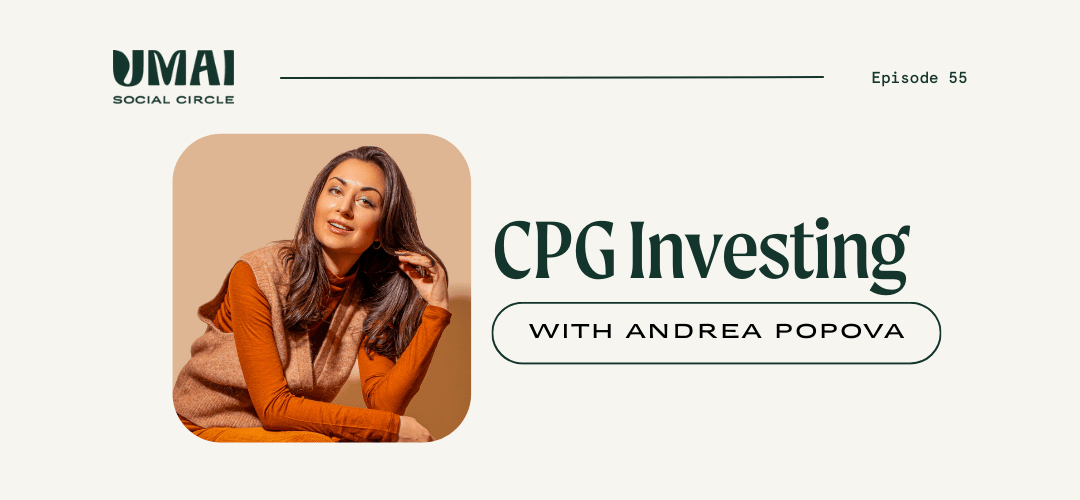
Welcome to the UMAI Social Circle, where we talk consumer goods tips to help business owners and marketers grow. We’re Alison and Karin, co-founders of UMAI Marketing, and today we’re being joined by Andrea Popova, co-founder and CEO of CPGD. Welcome.
Andrea Popova: [1:16]
Thank you. Thanks for having me.
Alison Smith: [1:17]
We’re super excited to talk to you. We’ve been following you and tracking you down for a while, so this is huge for us. And today we’re going to be talking about raising, investments, things that we haven’t really had the chance to talk in depth with. So yeah, we’re super pumped about it and we’re excited to learn all the things. But first, let’s get into your background. How’d you come to start CPGD and all the other fun things that you’re up to?
Andrea Popova: [1:49]
So I’ve always had an interest in E-commerce and retail. I started my career at Nielsen as a consultant at Walmart, which was such a cool time to be there because they had just acquired Bonobos and Jet.com. And so it was a very forward-thinking version of Walmart, and they were really getting into E-commerce, which was exciting. And then I went to PROS after that where I was one of their founding analysts creating dashboards and data systems to help them drive data-driven decisions. So that was where I really got into data and tech and how it can be applied to E-commerce. And that was also right around that time when I was a subscriber to CPGD and the owner of CPGD reached out to me and said that he had bought the business and that he was looking for a new owner. So he brought me in based on my experience, and it was just kind of a once-in-a-lifetime dream opportunity because you suddenly are the owner of a publication that you’re obsessed with.
So for the last three years I’ve been running a business that I once was just a subscriber to and watching it grow from 2,000 to 10,000 readers and a lot of them now founders who are my friends and my peers and brands I’ve helped get investments in and get different forms of traction in. And it was just such an amazing opportunity. So that’s a bit about me.
Karin Samelson: [3:06]
Oh, that’s so exciting that it just happened. He just really liked your experience. But for anybody who doesn’t know what CPGD is, can you give a very quick summary of what it is?
Andrea Popova: [3:20]
Oh, yes. CPGD stands for the Consumer Package Goods Directory, and it’s an online directory of digitally native brands and that it started as a free resource of these brands. And since then it’s sort of scaled into a newsletter where these brands are featured where we also feature different founders and agencies and services. And that’s where we have about 10,000 readers currently that read that on a weekly basis. And because of that newsletter, I’ve been able to then engage with the community in a way that now I’m able to source deal flow for the investors in the network. I work with a lot of agencies in the network to help them get clients. I help a lot of the founders on an advisorship where there’s even a mentorship basis. So yeah, it’s been a whirlwind, but that’s a bit about what exactly it is, kind of a watering hole of sorts.
Karin Samelson: [4:13]
Nice, nice. Yeah, it’s one of our, if not our favorite CPG newsletter, obsessed with the directory on the site and also the fact that you are helping not just CPG owners, you have agency partners, you have a whole slew of things you’re doing. Are you a one-woman team or what does that look like on the back end?
Andrea Popova: [4:34]
Yeah, the person who brought me on, he does own half the… I don’t know if I want to say this necessarily, but I guess the other person who brought me on, he owns part of the business and then I own the other part. And so he is not really necessarily a day-to-day operator, but so I guess you could consider me a one-woman show in that regard because I’m the only one operating the business. But I do have amazing interns who come in and currently have one from Brown University who’s just the best person ever. So it’s been awesome.
Karin Samelson: [5:06]
It is awesome. We love a good intern. So congratulations on finding a really amazing one. Well, let’s just dive into investments. So getting straight to the point here, how does someone make their first angel investment in a brand?
Andrea Popova: [5:22]
So getting involved in investing can be kind of daunting because you might want… There’s so many opportunities to invest. A lot of brands, especially right now are raising. And so I think the first thing is deciding what brand you want to invest in. And because there’s so many opportunities, I think it’s important for an angel investor to be really discerning, and that can be really impactful because if you invest in something early on that does really well, then that can really legitimize your career as an investor down the line.
So I would say yeah, being really discerning to start. And something you can do to do your due diligence, even though you’re not a fund, is leverage funds in your network to do the diligence sort of for you. So if you have an investment that you’re thinking of making, look at what other funds are investing in in the company, or if it’s very early, maybe look at later-stage companies that are in the same category of investing and ask them, “Do you think this is a brand that you would invest in if it got to a Series A or Series B?” And then in terms of the mechanics of it, typically you’ll have a call with the founder or the founding team and get an idea, a valuation and everything like that. But in terms of deciding on the brand itself, the metrics that I look at early stage are things like traction, profitability, margins, and looking at whether it can scale organically without paid media.
Alison Smith: [6:47]
Love that last one specifically, just because it’s something that we do, paid media, but we also do a slew of other things to build that strong foundation. And a lot of brands will come to us without that foundation and just want to throw money at the wall and see if it sticks sort of thing. So love that. You’re very in tune to that as well, and it’s like, yeah, this has to have legs. Very cool.
And have you found that being an angel investor and reaching out to firms or funds and asking for straight-up advice, like you mentioned, people are receptive to that in general?
Andrea Popova: [7:34]
Maybe it is because I already know a lot of these people already and talk to them on a regular basis, but…
Karin Samelson: [[7:41]
Talk to your friends and funds maybe first. Yes.
Andrea Popova: [7:45]
Yeah. I mean, if you’re interested in angel investing, maybe a first step is to have 20 or 30 calls with GPs or partners at early-stage consumer funds and understand how they’re thinking about investing. That’s what I would do is just do research among people who are already doing that and also actually joining networks like the angel group or syndicates that do a lot of the heavy lifting for you. That can be a great way to get your foot in the door, kind of dip your toe in, and then do some angel investing on your own after that.
Alison Smith: [8:17]
I love that actually, just doing 20 to 30 calls, just putting a number to it. Is it CPGD that got you into investing or was there a different avenue, or was it just being around all these brands constantly that made you really want to get into this?
Andrea Popova: [8:34]
I kind of always thought, “Will I go into venture capital, will I not?” Because I do love the entrepreneurial space, but I don’t want to run my own CPG business, but I love helping CPG businesses, so it’s kind of an easy way to do it as if you’re investing in them. But I didn’t really know if that would be possible for CPGD as a business to start doing until we found this platform called PIN that allows communities to raise capital together.
So the Uber alums use it to raise, the Y Combinator alums use it to raise. And so we were like, “Well, we have this community and we know that a lot of these people want to invest in CPG as well. Could we pull together money from that community using a platform called PIN to do that?” And so that’s when we first started thinking, could we actually do the investing ourselves if we reduce the technical barrier to entry and are able to use something like that. And that’s been really promising so far.
Alison Smith: [9:30]
Awesome. Is that still around, the PIN site?
Andrea Popova: [9:32]
Yeah, well, I am legally not allowed to say if we’re actively raising, I think, so what can I say? That yeah, PIN is thriving and we are actively working with them to maximize the impact of our community in CPG.
Alison Smith: [9:51]
Awesome.
Karin Samelson: [9:53]
So since you always have your eye on CPG brands right now, what are a few brands that are some of your faves that you’re interested in and why, what makes them compelling?
Andrea Popova: [10:04]
Yeah. Well, one brand that I’m really excited about is 4AM Skin. It’s founded by two amazing female founders and when they started the brand, they started also building their own social media followings, which ended up being really impactful because now they’re able to scale their sales pretty organically. I don’t think they’ve ever spent a dollar on paid media. They’ve actually grown through just organic mentions with the other influencers and creators that they partner with and also their own social media. And the brand itself is just very eye-catching and luxurious, and so it just garners a lot of attention. So that is a brand that I’m really excited about and the numbers are also really strong. So definitely one to watch out for in terms of content and unique, I don’t know how to describe it, unique ways of communicating with their community.
Omsom is a really cool example. They’re an Asian food brand. They started off doing sauces and now they do noodles as well. And just the way that they build their community online is very authentic and raw and open and the way the founders live their lives is also an expression of that. So it’s just really cool to see, again, two female founders who are actually sisters in this case, scale a business that way.
Karin Samelson: [11:26]
I love that. And we always preach founder forward content just because of the connection that you can make and social is all about building community. So we completely align with that. So both of those examples were very, very strong founder stories, founder forward. Is that a huge thing that you look for other than the margin and profitability? And would you recommend other small brands be open to that kind of strategy?
Andrea Popova: [11:53]
Oh yeah, I totally agree that founder forward is the way. In fact, there’s this tool called Tolstoy that allows you to have videos embedded on your website. They would probably hate that I describe it this way, but it’s like a pop-up that pops up on your website. But it’s kind of like a mini way of you being able to say, “Hi, I’m the founder,” on your website. And I think that that’s why it leads to such stronger conversion rates on websites because it is so founder forward. And yeah, I just think the reason CPG is such a cool industry to be in is because the founders. So the more that people can lean into who they are and why they started the business, the better for their ability to raise and also for customer’s ability to engage with or feel the product resonates with them.
Alison Smith: [12:41]
Yeah, I was on a site the other day. It was a small CPG startup, and she had her Tolstoy video, and I listened to her story three times on repeat because it was good. She knew what she was doing. It was good. It instantly felt connected. I mean, just adding the human element to your shoppable website is, I’m sure it increases conversion rates, but it also just feels better as well as a consumer. I’m curious, what types of questions do founders who you’re potentially investing in, what type of questions do they ask you that you think are super smart or that you love and kind of more pique your interest into their brand?
Andrea Popova: [13:34]
What types of questions do founders ask me that pique my interest? What’s an example?
Alison Smith: [13:40]
Yeah, when they’re raising your potential investor, do they ask you any questions that you’re like, “That was a good question. It makes me want to work with them further.”
Andrea Popova: [13:53]
I think that any founder who’s looking for more than just capital, I think that’s always an important thing to seek out. So if a founder is asking like, “Okay, you’re investing this money in me, but what other things are you going to be providing? As an investor in this business, what are you committing to in terms of growing the business?” And I think that’s a perfect question for CPGD because we do so much beyond just investing capital. We have discounts and deals that we’ve curated on SaaS tools and agencies that we give our investments. We have advisors in our network. We have a talent pool that we can draw from. So there’s just so many things on top of the money. Obviously, the money is secondary even to all the resources and intros we can provide. So yeah, I think that that is a really good question to ask your investors.
Alison Smith: [14:38]
And how does CPGD get access to all of the CPG deals?
Andrea Popova: [14:40]
All the deals that we come across are inbound from our network. It’s pretty crazy. Either they come from the founders themselves because so many founders do subscribe to CPGD, and so they’ll tell us when they’re raising, or an investor in our network will say, “Have you seen this deal that I’ve come across?” I’m also a scout and a venture partner for several funds, so they sometimes show me deals that they’re looking at that maybe are too early for them or too late for them. So it really is all just inbound in the community, which is awesome.
Karin Samelson: [15:13]
That is awesome. I mean, when you build something so strong and there’s so many people that know about that reputation is really nice. There’s a lot of trust being built between what you’re doing and the brands that are relying on you here. So I love that. What are some brands that you’ve recently invested in?
Andrea Popova: [15:30]
I recently invested personally in Flaus, which is Flaus. I don’t know best to pronounce it, but it’s F-L-A-U-S, and it’s a really cool, really cool brand. It’s the first-ever electric flosser. And I invested in it because I talked with the founder and after talking to the founder for two minutes, I was sold. I was truly just like, “You have a vision and I am on that. I’m going to ride into the night with you till the day I die. This is just the best business ever.” That’s kind of how I left that conversation. And I have rarely felt that way. And I actually have only made just a couple personal investments in CPG brands personally versus the business, and that was one of them. So that just goes to show how strong of a business that it really feels like from talking to her.
Karin Samelson: [16:22]
A two-minute conversation. What on earth did she share with you in two minutes that had you sold like that?
Andrea Popova: [16:30]
I had follow-up conversations since then, of course, but I was already sold in that conversation. She told me about the long-term vision of the brand, how they were going to scale and different channels they were going to scale in. And I was like, “You are right.” And also the patent that they have on the business is also really promising. So yeah, very cool company.
Karin Samelson: [16:51]
That’s awesome. I have definitely received the ads, and I’m very intrigued because it is hard to remember to floss and of if it’s just right on my counter like that, super easy. So maybe I’ll take a harder look at it and see what stories they’re telling through their content.
Andrea Popova: [17:09]
Totally. Oh my gosh, yeah. You got to tell me if you try it.
Karin Samelson: [17:14]
I will. Now that I know that you’re an investor, that’s great. So what makes a CPG investment opportunity a good one, a smart one, when there are so many brands raising right now?
Andrea Popova: [17:26]
I think that right now we’re in a time of really focusing more on profitability and scale than ever before. Well, maybe not ever, ever before, but the most in the last decade. So a good investment right now is maybe even the unsexy brands that you don’t even see on trendy influencers. Maybe right now the best brands to invest in might be just brands with really solid growth that are actually targeting middle America and have strong margins. Those are really compelling businesses that are probably really acquirable on the other side. But a business that combines both hype with scalability, I think is just a unicorn. And that’s why I love brands like 4AM Skin, for example, that I think are doing really well in both regards.
Karin Samelson: [18:21]
I really have to take a look at 4AM Skin. I’ve never heard of it. I’m like, “Do I need this now?”
Andrea Popova: [18:26]
You do. I have them in my room right there.
Karin Samelson: [18:29]
Oh, perfect. Love it.
Alison Smith: [18;33]
You mentioned kind of a change towards brands feeling more that they need that profitability in CPG. We’ve definitely seen that too throughout the past year. Have you seen any other changes in the raising landscape in general as well?
Andrea Popova: [18:55]
Well, a lot of funds right now are having trouble raising, so I think that funds are also being way more, I don’t want to say stingy, because that almost has a negative connotation, but they’re just being more maybe selective because they have to be about what investments they make, and so brands are feeling that burn as well. But yeah, that’s definitely one trend is that I feel like it’s really coming even from the higher layer of the LPs and the funds themselves.
Alison Smith: [19:28]
Yeah, it’s so interesting that that wasn’t as important for some brands previously, and now it’s more like profitability is at the top of importance for at least a lot of the brands that we’re working with, which is exciting and a new challenge as well. It really puts our marketing skills to the test. But yeah, we’ve seen a lot of brands that we work with having to trim the fat in terms of looking really hard at their operations, their marketing as well, every single factor that goes into making a beautiful product. So yeah, kind of exciting new territory to work in. I’m going to use the word exciting, another way to describe it.
Andrea Popova: [20:20]
Marketing has always been about being creative with what you have, but now more than ever, brands have to be very creative and scrappy. Scrappy is probably the stronger word to use there.
Alison Smith: [20:31]
Yeah. Yeah, definitely.
Karin Samelson: [20:33]
Awesome, Andrea. Well, we’re so thankful that you came and shared wealth of knowledge about a subject that we really haven’t breached too much on the podcast. So we appreciate you being here, and we appreciate what you’re doing with CPGD. We reference it and we look to it all the time. And I mean, other brands should be too, regardless of if you’re looking to raise or if you’re looking for an agency partner, but just to see what the landscape is like, see what’s new, see what’s hot. So thank you for doing that work, but would you like to leave the audience with a link or a call to action, a final statement?
Andrea Popova: [21:09]
Well, thank you so much, first of all, for having me on. It’s been really amazing to meet you guys and to talk to you face to face. So yeah, thank you for having me on. I would just say if anyone is interested in investing or learning more about CPG, we have some resources on the website at cpgd.xyz, so check it out.
Karin Samelson: [21:30]
The best name, I love it.
Karin Samelson: [21:31]
Thanks for listening to the UMAI Social Circle, y’all. We’re here to support you in your CPG journey, so be sure to subscribe so you don’t miss any new podcast episodes. And while you’re a it, please leave us a review on your listening platform of choice. Shoot us a DM @umaimarketing on Instagram if you have any topics you want us to cover on new podcast episodes.
Alison Smith: [21:51]
And don’t forget to access our free masterclass where we’re showing you how to create a solid marketing strategy. You can access that at umaimarketing.com/masterclass, and we’ll meet you back here for the next episode.






 Need help fulfilling your orders? Click

